

Before declaring “___ is dead”, consider that you may just be boring.
My Media Diet: A monthly media and culture column by Goat US Strategy Manager, Liv Molho

Author: Liv Molho, Strategy Manager, The Goat Agency
I’ve said it before and I’ll say it again: We haven’t had monoculture since kelly clarkson won american idol.
What I mean by that, is that online echo chambers are not just political anymore. Every social media platform is so oversaturated with content from creators, brands and bots, that everyone is experiencing culture in a different way. Even more, different cultures all together.
One through line though, is what I would like to call “Judgement Currency“.
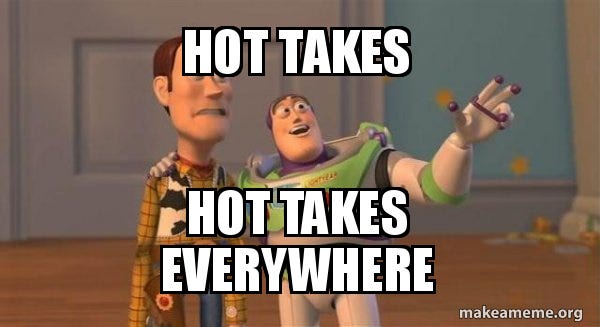
Hot takes have become a cultural pandemic. Everyone feels the need to make a conclusion on everything all the time. Everyone is writing a think-piece. Everyone is racing their peers to be the first to predict the next trend, and complete their retrospective on the last one.
Ultimately, what I don’t think people realize is that while their social media “take” may appear thoughtful or clever to some, it is most likely not true for everyone - because other people are on entirely different versions of the internet.
Don’t get me wrong - I do recognize the irony of writing a think-piece on how think-pieces are killing internet culture. I’m not declaring that they must go away all together. I am just wondering if maybe, we take a step back and make a little more room for nuance. What I’ve been thinking about is the overconfidence of internet commentary.
The internet rewards certainty over curiosity.
When people are online and see that the influencers, brands, and media contributors in general are giving so much value to cultural declarations like:
“___ is dead”
“___ is in”
“___ is bad”
“___ is back”
Etc… it infiltrates the way people think.
Telling people what to think is a great way to sell products, but is also a great way to keep them from forming their own opinions. Besides the obvious downsides to this, it also disregards the fact that most of the time these cultural conclusions are not actually even true across the wider internet, and therefore start to feel more like saying things for the sake of having something to say.
Basically, I think the person declaring that a certain culture/trend is “dead” simply isn’t looking very hard.

 Tiktok failed to load.
Enable 3rd party cookies or use another browser
One of the strangest things about algorithmic feeds is that they slowly convince us they’re objective. We stop seeing them as personalized recommendations and start treating them like reality. If your TikTok is boring, you assume TikTok is boring. If every creator sounds the same, you conclude creativity is dead. If you’ve seen one too many “deinfluencing” videos, suddenly luxury is over, maximalism is back, skinny jeans are dead again, sincerity is cringe, irony is dead... until next Tuesday.
But your algorithm is not the culture: it’s a mirror. (And it’s reflecting your own habits more than what’s actually happening.)
We consume so much content that we hit diminishing returns incredibly quickly. The fifth creator making a trend feels derivative. The twentieth feels totally unbearable. Eventually, we conclude the trend itself has run its course.
But, that only feels true because we watched those twenty videos in under an hour. Someone else, on an entirely different corner of the internet, is still seeing it for the first time. This matters because marketers, strategists (hi), and creators are especially guilty of treating their own feeds like market research (working on it).
“One of the strangest things about algorithmic feeds is that they slowly convince us they’re objective.”
We spend all day immersed in internet culture. Then we mistake our own exhaustion for everyone else’s. We declare that audiences are tired of something when really we’re tired of something.
Sometimes a format isn’t dead. You’ve just been looking at it for eight hours a day.
So before declaring that something is dead, over, cringe, back, or the future… Ask yourself this question: is culture actually changing? Or am I just tired of my own feed?
Our urgency to reach conclusions is making us worse cultural observers. We stop exploring. We stop looking for contradictions. We stop venturing outside our own algorithm long enough to discover that someone else is having an entirely different cultural experience.
Curiosity is infinitely more interesting than certainty, and if you’ve decided you’ve already seen everything the internet has to offer...
You may just be boring.
…
Great read! Really like the concept of the algorithm as a mirror